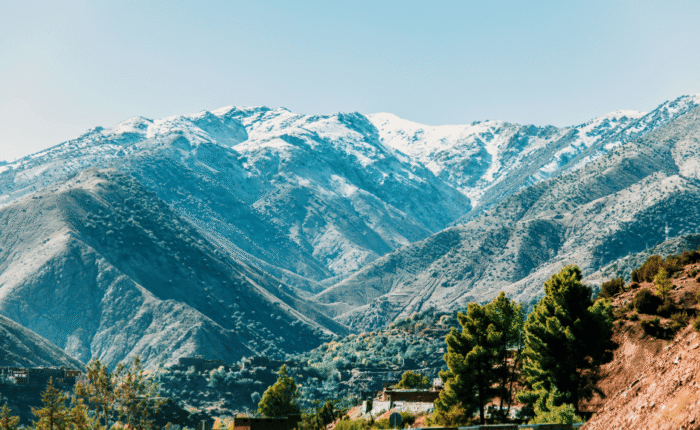
This is the day trip that crosses the High Atlas. The road out of Marrakech climbs to the Tizi n Tichka, at 2260 metres the highest paved pass in Morocco, then drops down the far side into a landscape that looks nothing like the one you left: bare red rock, palm-filled riverbeds and mud-brick villages the same colour as the ground.
The destination is the ksar of Ait Ben Haddou, a fortified village of packed earth stacked up a hillside above the Ounila river. It has been a UNESCO World Heritage Site since 1987, and because it looks the way it does, film crews have used it for decades, from Lawrence of Arabia onward.
Most itineraries add Ouarzazate on the way back, where the studios and the Kasbah Taourirt sit at the edge of the desert plain. It is a long day with a lot of driving, but the pass alone is worth the trip.
Early pickup from your accommodation in Marrakech, because this day covers a lot of ground. The road heads southeast across the plain and then begins the climb into the High Atlas, tightening into switchbacks as it goes. There are stops at the viewpoints, where you can see the road you have just driven stacked up the mountainside below.
The summit is the Tizi n Tichka at 2260 metres, the highest paved pass in the country. The change on the far side is abrupt: the green of the Marrakech side gives way to bare red rock, and the villages are built from the earth they stand on.
A side road leads to Ait Ben Haddou. The modern village sits on the near bank; the old ksar is across the Ounila riverbed, which is usually low enough to cross on foot or on stepping stones. The climb through the ksar takes you past earthen houses stacked one above the other to the agadir, the fortified granary at the top, and the view from there runs the length of the valley.
After free time for lunch, the road continues to Ouarzazate, thirty minutes further on. You can see the Kasbah Taourirt at the edge of town and the film studios that have made the place a name in the industry. From there the route turns back over the Tizi n Tichka, reaching Marrakech in the evening.
About four hours each way, including the mountain pass and photo stops. It is the longest of the Marrakech day trips, so expect an early start and an evening return.
It is paved the whole way and in good condition, but it is a mountain road with continuous switchbacks. If you are prone to travel sickness, sit in the front and bring something for it.
Yes. The old village is open and several of the houses can be visited. The walk up to the granary at the top takes about twenty minutes at an easy pace.
Yes, as a stop on the return leg. There is time to see the Kasbah Taourirt and the outside of the studios, though a full studio visit would make the day too long.
Yes. Private air-conditioned vehicle and your own driver, with the pace adjusted to what you want to see.
Comfortable shoes for the climb through the ksar, sun protection, and a warm layer for the pass, which is noticeably colder than Marrakech in any season.
If you want to understand why the south of Morocco looks the way it does, this is the day that shows you. In a few hours you cross from the irrigated plain around Marrakech to the edge of the pre-Sahara, over the highest road in the country, and end up in a mud-brick village that has been standing since long before anyone pointed a camera at it. It is the best single day for landscape out of Marrakech.