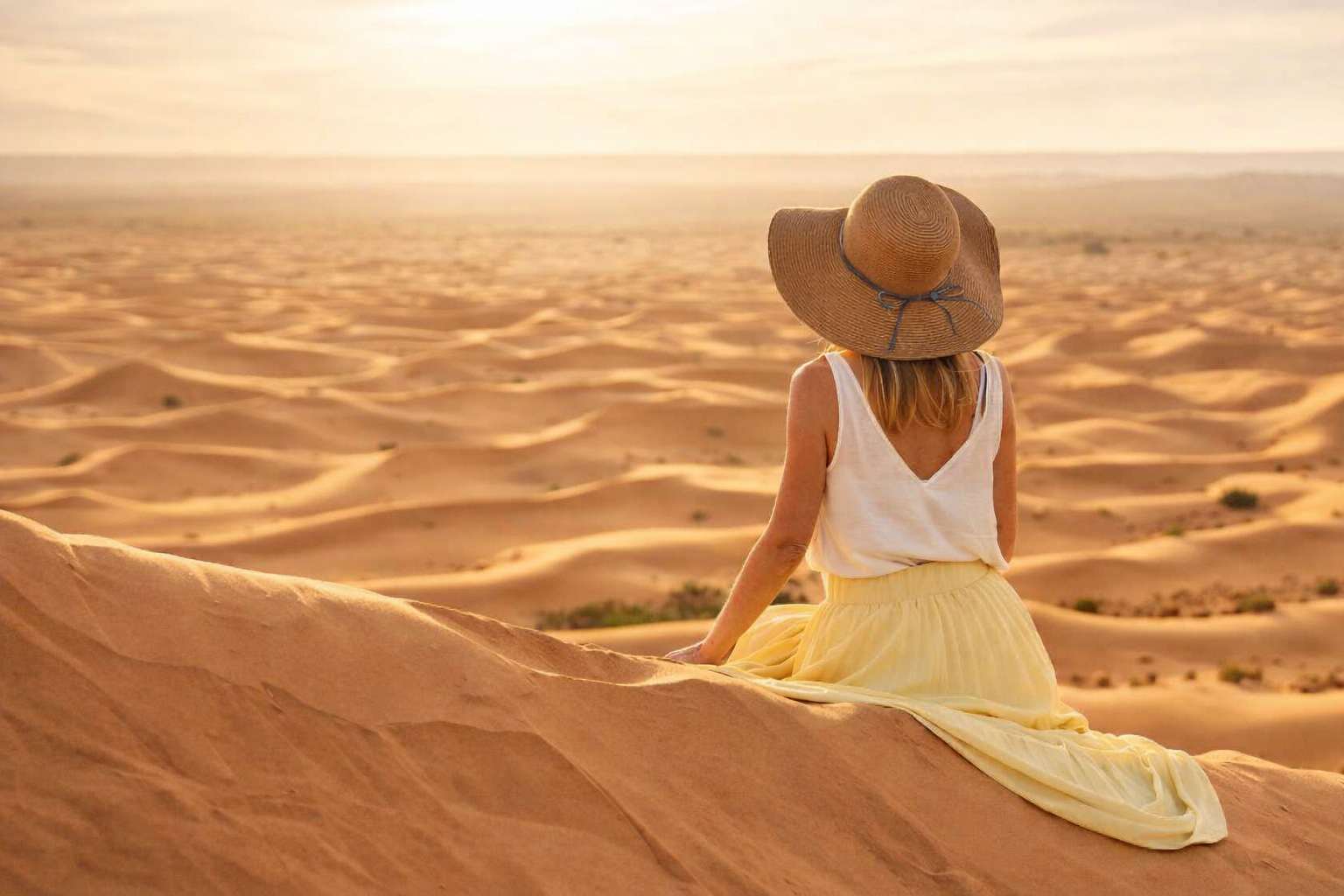
The 13 Days Morocco Tour from Tangier runs the full length of the country, from the Strait of Gibraltar to the Sahara and back up the Atlantic to Casablanca. It is the only Tangier itinerary here with room for both southern roads.
Most tours choose between the gorge route through Todra and the Dades and the oasis route down the Draa. Thirteen days does both: you come west from Merzouga through the gorges, turn south at Ouarzazate into the Draa as far as Zagora, and only then cross the High Atlas to Marrakech.
The north gets three days, Chefchaouen and the desert each get a free day, and Marrakech gets a full day before the coast road north to Casablanca for the flight home.
Pickup at Tangier airport, at the ferry port or at your hotel. The morning covers the Kasbah above the bay, the small medina and the Grand Socco.
Out of town you reach Cape Spartel, where the Atlantic meets the Mediterranean, and the Caves of Hercules below it, open to the sea through a gap shaped like the map of Africa.
The afternoon runs south to Asilah, a walled port of whitewashed houses whose ramparts are repainted with murals every summer. Return to Tangier for the night.
Accommodation: Hotel in Tangier
East along the Mediterranean to Tetouan, whose UNESCO-listed medina was built by refugees from Granada and remains one of the least visited in the country.
Lunch there, then the road climbs into the Rif mountains.
Arrival in Chefchaouen in the afternoon, with time to walk up to the Spanish mosque above the town for the view over the blue rooftops at sunset.
Accommodation: Riad or hotel in Chefchaouen
No driving today. The medina is steep, small and painted lime blue, and best explored without a route.
The kasbah in the main square has a garden and a tower with a view; Ras el Maa, the spring at the top of the town, is a short climb above it.
The Akchour waterfalls and the natural arch known as the God Bridge are about an hour away and make a good half-day walk.
Accommodation: Riad or hotel in Chefchaouen
Down out of the Rif to Volubilis, the Roman provincial capital, where mosaic floors, the basilica and the triumphal arch stand in farmland below Moulay Idriss.
A stop in Meknes for the Bab Mansour gate, the walls and the royal granaries.
Arrival in Fes in the late afternoon, evening free.
Accommodation: Riad or hotel in Fes
A full day in Fes el Bali, a working ninth-century city with no cars and around nine thousand lanes.
The circuit covers the Bou Inania and Attarine madrasas, the Nejjarine fountain and woodwork museum, the Al Quaraouiyine mosque and library, and the Chouara tanneries.
A licensed guide is recommended. The afternoon is free for the souks or the Merenid tombs above the city at sunset.
Accommodation: Riad or hotel in Fes
South across the Middle Atlas through Ifrane and the cedar forest at Azrou, where Barbary macaques gather by the road.
Lunch at Midelt, then down into the Ziz Valley with its long belt of date palms and the viewpoint above the gorge.
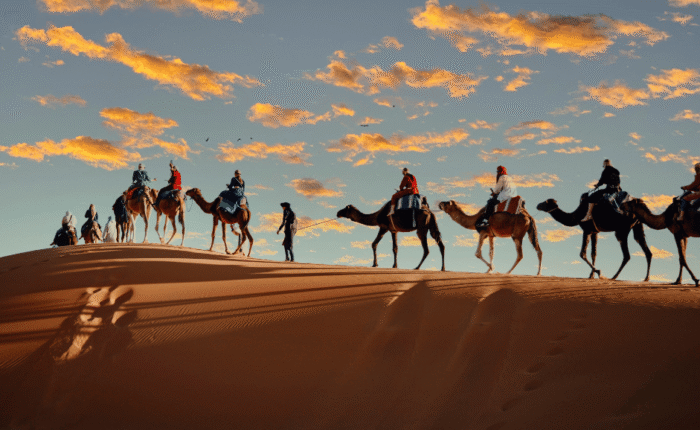
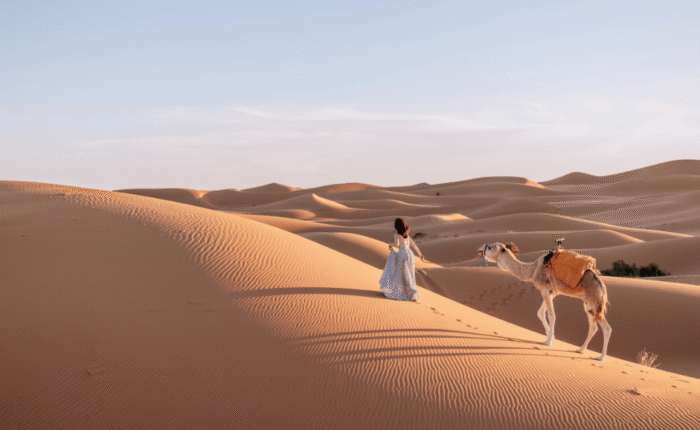
Arrival at Merzouga in the late afternoon, then the camel ride into Erg Chebbi, reaching camp at sunset for dinner and drums under the tent.
Accommodation: Berber desert camp, Erg Chebbi
Sunrise from a dune crest, camel ride back, breakfast and a shower at your hotel.
A 4×4 circuit fills the day: tea with a nomad family on the hamada, the seasonal lake at Dayet Srji, the black volcanic desert and the abandoned kohl mines at Mfis.
Late afternoon at Khamlia for a Gnaoua session, then a second sunset at the edge of the erg.
Accommodation: Hotel or kasbah in Merzouga
West with stops at Rissani and its covered souk and at Erfoud for the fossil workshops.
The afternoon reaches Todra Gorge, where limestone walls of about 300 metres close to a few paces above the streambed. A walk on the valley floor is the best part of the day.
Short drive on to the Dades Valley, with time for the winding gorge road above your hotel.
Accommodation: Hotel or guesthouse in the Dades Valley
A short day. El Kelaa des Mgouna first, where most of the country damask rose crop is distilled into water and oil, then the Skoura oasis and Kasbah Amerhidil among the palms.
Arrival in Ouarzazate in the afternoon, with time for the Taourirt Kasbah and the Atlas film studios, where sets from several international productions still stand.
Ouarzazate is the junction of the two southern roads, and tomorrow you take the one most itineraries skip.
Accommodation: Hotel in Ouarzazate
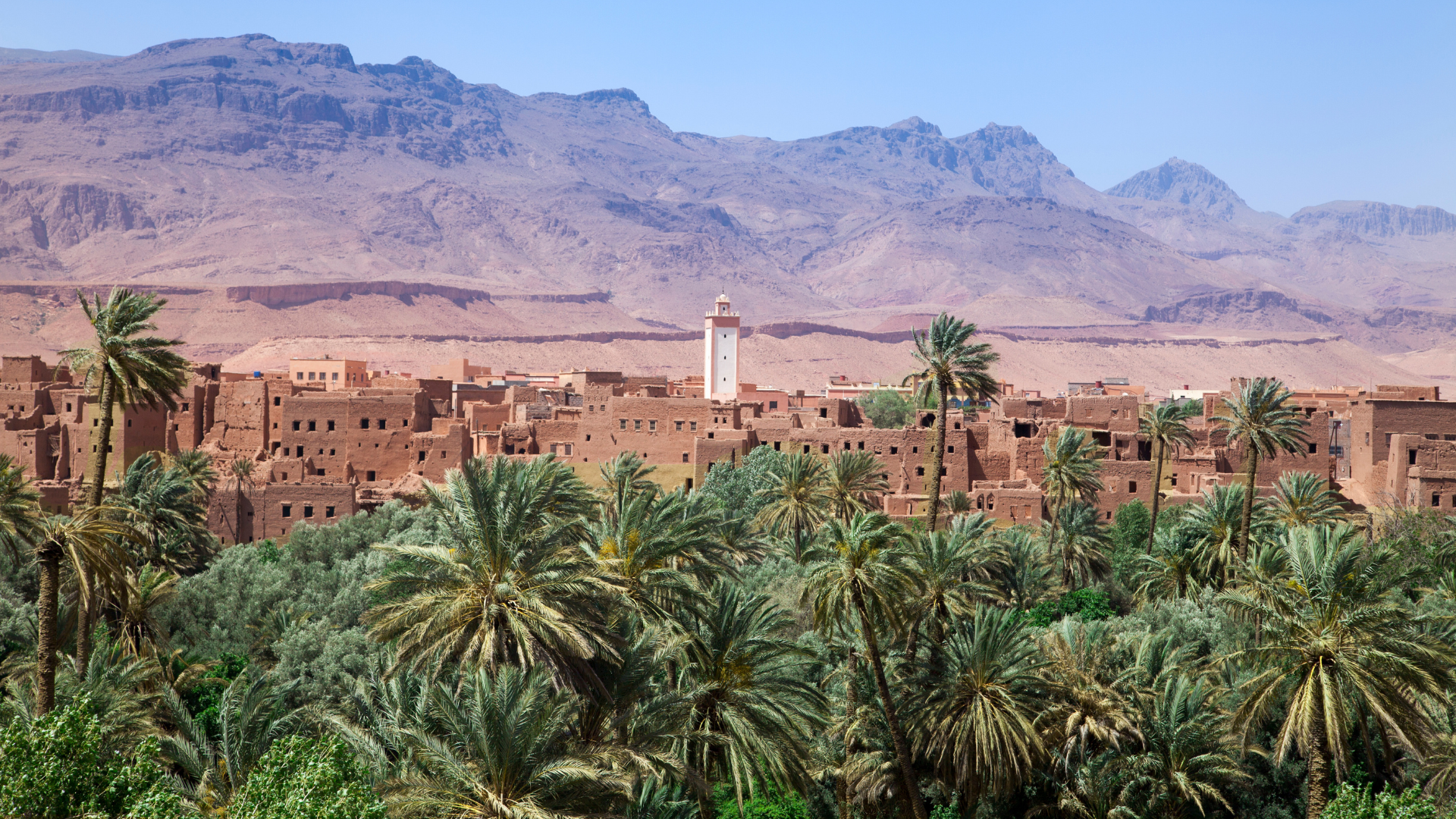
South over the Tizi n Tinififft pass into the Draa Valley, the longest oasis in Morocco, a thin green line of date palms and mud-brick ksour running through bare country.
You stop at Agdz below the Jbel Kissane, where the palm grove begins, with time to walk into one of the fortified villages along the river.
Arrival in Zagora in the afternoon. The old sign pointing to Timbuktu, fifty-two days by camel, stands on the edge of town, and the palm grove is best in the last hour of light.
Accommodation: Kasbah or hotel near Zagora
North again through the Draa, with time for the ksour and palm groves you passed the other way.
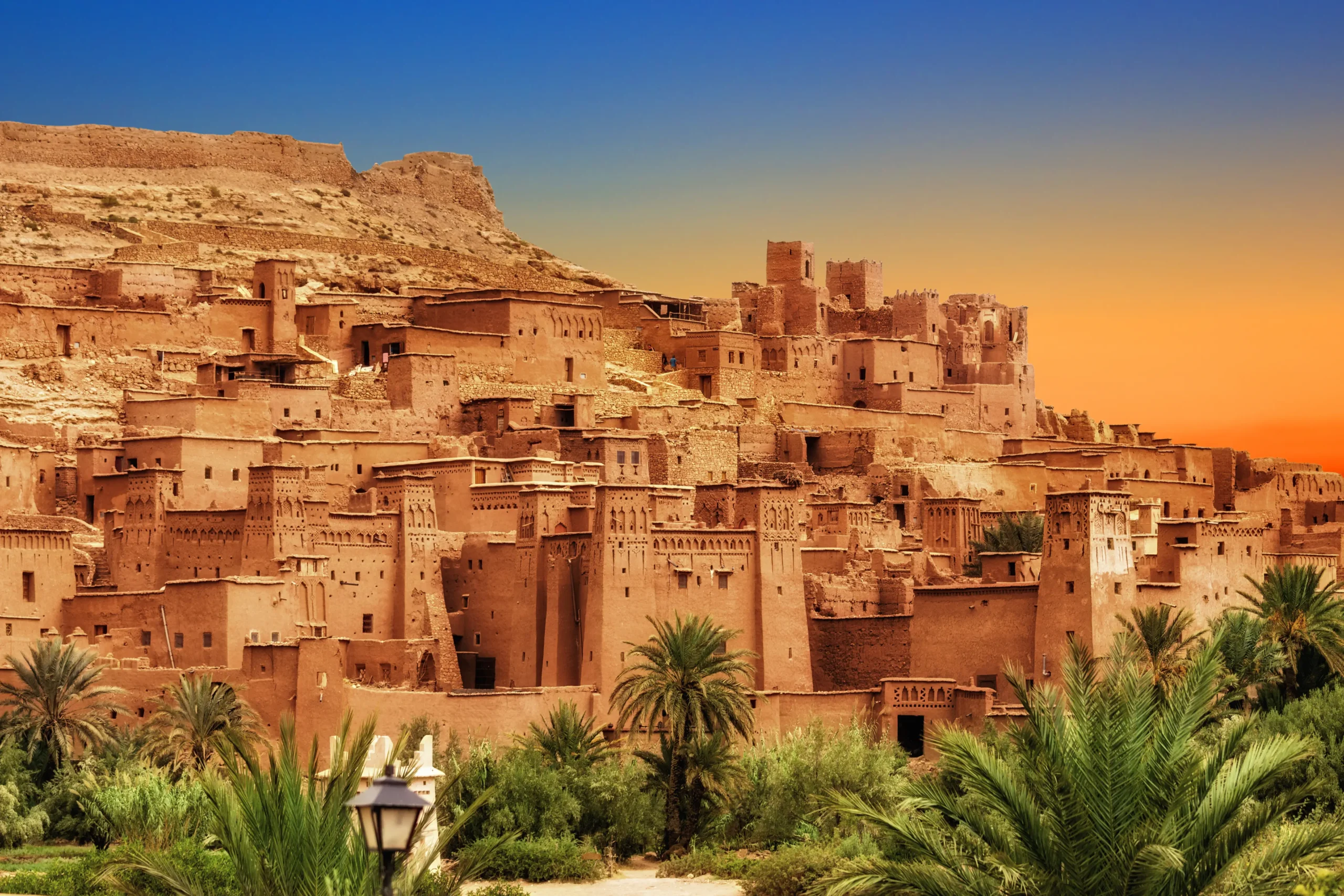
Beyond Ouarzazate you turn off for Ait Ben Haddou, cross the riverbed and climb through the earthen ksar to the granary at the top, with the Ounila valley below.
The last stage crosses the High Atlas by the Tizi n Tichka pass, with viewpoints on the descent into Marrakech.
Accommodation: Riad or hotel in Marrakech
A guided day covering the Koutoubia minaret, the Saadian tombs, the Bahia Palace and the Ben Youssef Madrasa.
The afternoon is free for the souks, the Majorelle garden and the Yves Saint Laurent museum, or a hammam after twelve days on the road.
Jemaa el Fna changes entirely after dark and is worth an hour on foot.
Accommodation: Riad or hotel in Marrakech
North-west to the Atlantic, with a stop at El Jadida, where the Portuguese cistern beneath the old town is one of the strangest interiors in Morocco, its columns reflected in a few centimetres of water.
Continue up the coast to Casablanca for the Hassan II Mosque, built out over the sea with a minaret of 210 metres, and a drive along the Corniche.
Drop-off at Casablanca airport, at the port or at your hotel, timed around your flight.
Because returning to Tangier would add a full day of driving to no purpose. Casablanca has the country main international airport and sits on the way. If you need Tangier, we can add the leg or book an internal flight.
Because thirteen days has room for it. The gorge route and the Draa oasis route are completely different landscapes, and most itineraries force a choice.
Yes. A camp night in the Zagora sands can replace the kasbah hotel, giving you two desert camps in different terrain.
Two: Fes to Merzouga and Zagora to Marrakech. Three days have no transfer at all and several others are short.
Yes. Pickup at Tanger Med or the city port is standard, and the first day is built around Tangier so a mid-morning sailing still works.
Yes. Common changes are adding Essaouira, swapping a Marrakech night for the Ouzoud waterfalls, or reversing the whole route to start in Casablanca.
Thirteen days is enough to travel Morocco end to end rather than sample it. Two seas, three mountain ranges, the Sahara with a free day, both southern roads, and the two greatest medinas in the country.
Nothing is driven twice except the short Draa stretch, which is worth seeing in both directions, and the whole route runs privately with your own vehicle and driver.