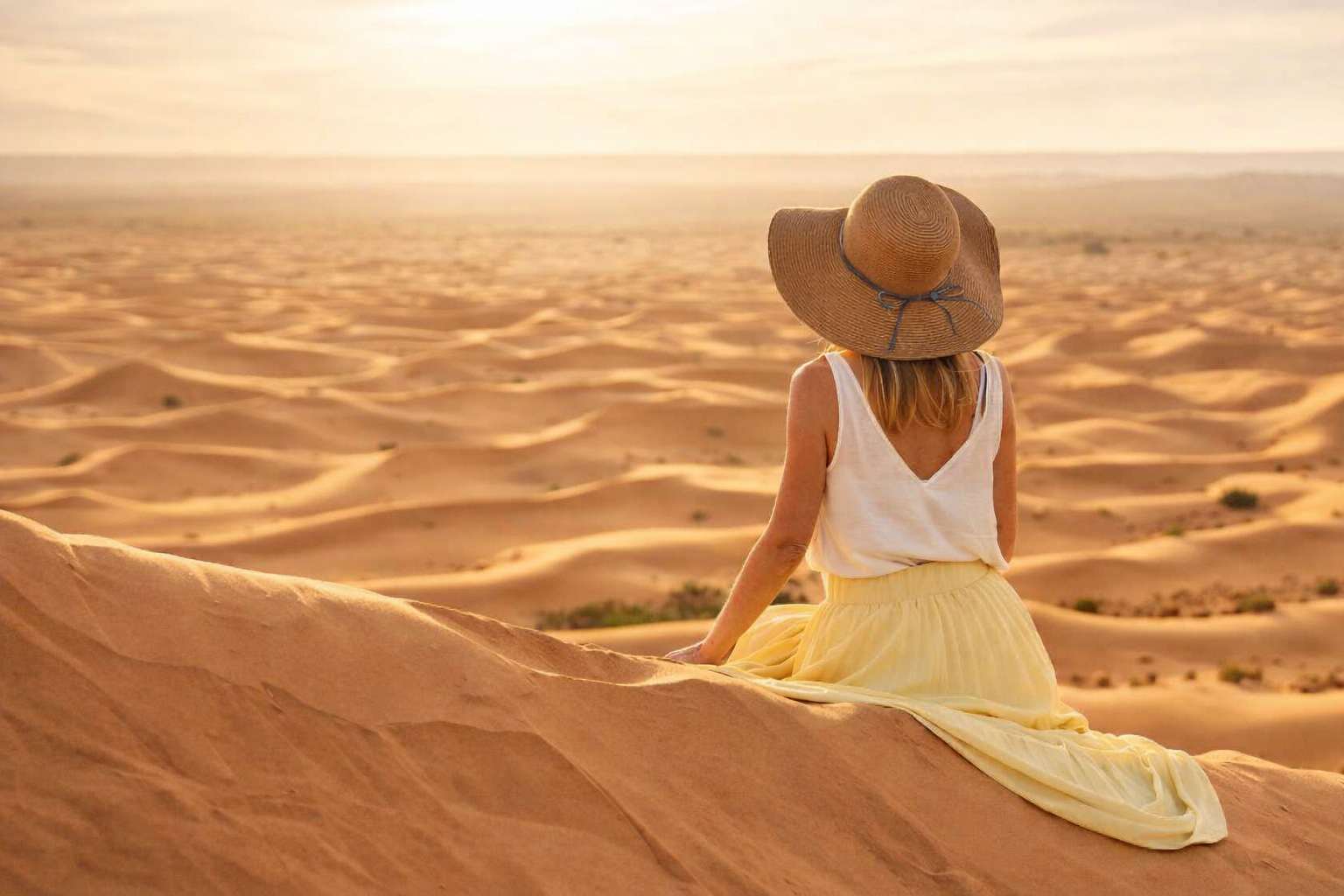
Three nights is enough to leave the erg behind and come back to it. The route works out from the dunes into the country around them, which is where the desert stops being sand and becomes something harder: black stone hamada, dry valleys with thorn trees, and the seasonal grazing where the nomad families move their herds.
You sleep in three different camps, none of them within sight of the last, and the pace stays slow throughout with long rests through the middle of each day. There is time out here to do nothing, which on a shorter trek there never is.
This is the version for people who came to Morocco for the Sahara specifically, and who want to travel in it rather than visit it.
Afternoon departure from Merzouga into the western dunes, carrying on past the usual overnight camps into empty sand. Sunset from a high crest, then the first camp, dinner and a fire.
East across the dune chains through the wide hard-floored corridors between them, with a long rest in shade through the middle of the day. In the afternoon you reach the eastern margin, where old wells still hold water and a few palms mark the line of the caravan road running south. The second camp is pitched out here, and it is very quiet.
Turn out of the sand altogether. Beyond the erg the ground turns to hamada, flat black stone that runs to the horizon and looks nothing like the dunes an hour behind you. This is where the fossil beds are; the whole area was seabed, and ammonites and trilobites come out of the rock here.
The route crosses into dry valleys with thorn trees where nomad families bring their goats and camels for the seasonal grazing. There is time with a family here, and the visit is longer and less hurried than on the shorter treks. The third camp is set among the valleys, on stone rather than sand.
Sunrise over the hamada, which is a harder and stranger light than sunrise over the dunes. After breakfast the route turns back west, re-entering the erg from the far side and crossing the last of the sand to Merzouga, arriving in the middle of the day. A 4×4 return can be arranged for the final leg on request.
The days are long but the pace is slow and there is a long rest in the middle of each one. The main difficulty is cumulative: three days in a saddle leaves most people stiff. Walking sections are always an option and the camels carry the bags.
No. The handlers manage the animals and lead throughout. What you need is tolerance for basic facilities and long days outdoors.
The hamada, the flat stone plain beyond the sand. It was seabed once, and fossils weather out of it; ammonites and trilobites are common. It is the part of the Sahara most visitors never see, because the dunes are what people come for.
Yes. The first is a standard dune camp, the second is smaller and much further out on the eastern margin, and the third is pitched on stone among the nomad valleys rather than in sand.
From November to February it can approach freezing before dawn, and the stone country holds the cold worse than the sand. Blankets are provided but bring proper warm layers.
It runs year round, but between June and August the middle of the day is severe and the itinerary rests through it. Spring and autumn are much better for a trek of this length.
Most desert trips in Morocco are a night at the edge of the sand. This is a journey: three nights, three camps, none within sight of the last, out across the erg to the caravan wells and then off the sand entirely into the black hamada and the nomad valleys beyond. It is the only version long enough that the desert stops being scenery and starts being the place you are living in for a few days.